
Many people like to use dividends as a way to get paid. In fact, some people can live off their dividend payments alone, each and every month. But if you are heading down that path, do you have a plan for getting there safely?
I’ve seen it a lot. People chase yields, and they end up getting burned. Companies in the U.S. that pay dividends often pay anywhere from 0.5% to about 3%. Real Estate Investment Trusts and BDCs tend to pay higher, but they are more specialized, and you have to really know those business types to keep up with the trends.
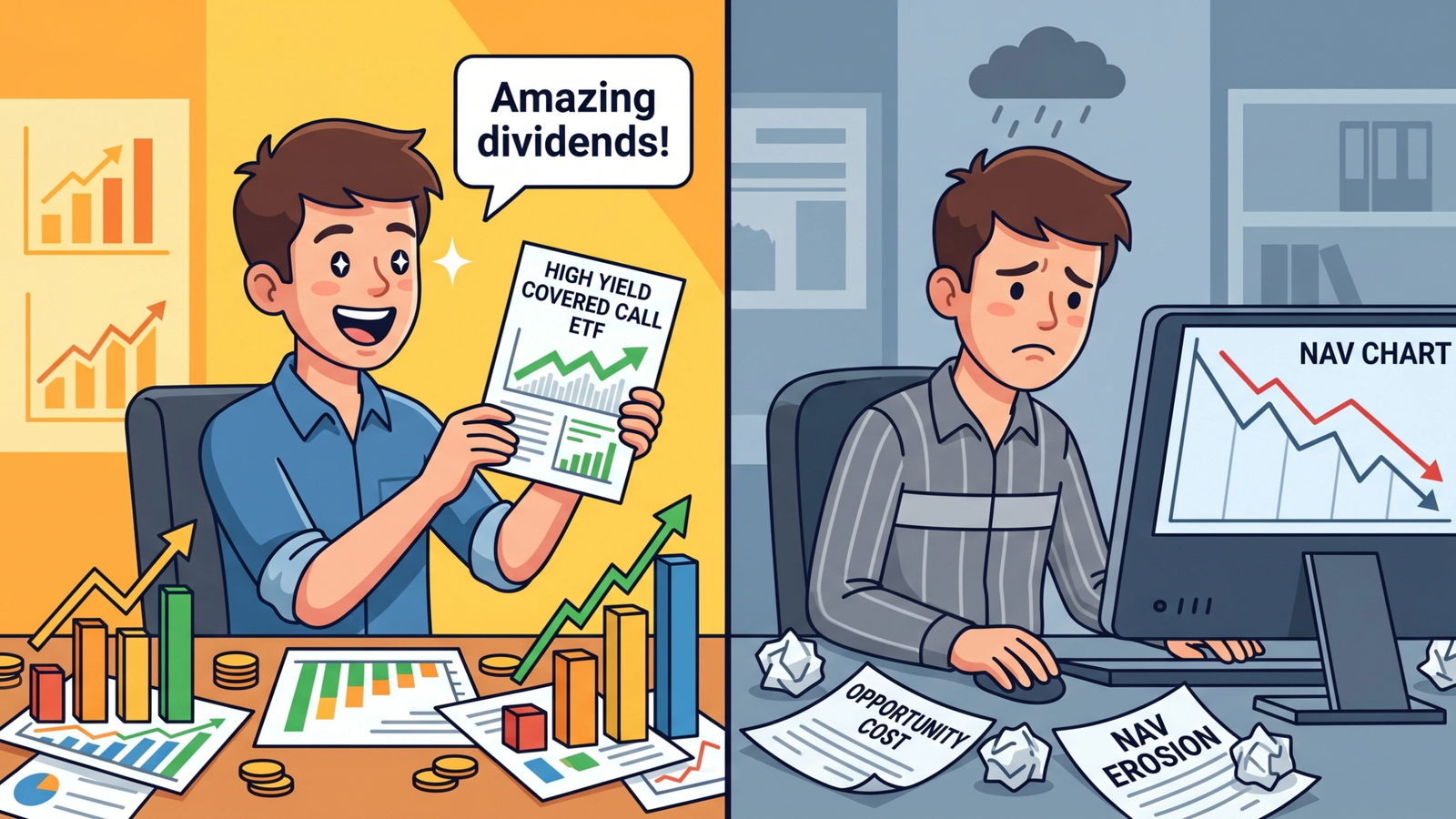
Now, ETFs are jumping on the dividend bandwagon, using all kinds of creative ways to boost yields, in true Wall Street fashion. One such example is Covered Call ETFs. Simply put, these are ETFs whose managers boost yield by selling covered calls on their positions.
Covered calls themselves are nothing new and have existed for decades. However, they are often touted as low-risk option strategies, which may be true in the context of options investing, but they are not without risk. One of the biggest risks is a concept known as NAV erosion.
If you are not familiar with NAV, it stands for Net Asset Value, which is the price of an instrument or fund.
I wrote an article on my financial website that covers all the terms you need to know about covered calls, so I won’t repeat it here. Instead, I will link to that article to see for yourself.
But in a nutshell, NAV erosion occurs at the extremes. When you own 100 shares of a stock, if the stock is optionable, you can sell a call option on those 100 shares (or multiples of 100, if so desired). If the stock explodes to the upside, the option will be called, and you’ll be required to sell your 100 shares at the current exploded price, and you’ll have to sell to the option holder at the lower strike price for a loss. As an individual investor, you are not required to buy another 100 shares, but the same is not true for ETFs. Depending on their agreement to become an ETF, they will likely have to buy 100 shares at the higher (exploded) price and write calls on them.
Conversely, when a stock drops significantly, the covered calls will expire worthless. In this case, the ETF manager retains the stock (since the covered call expired). However, their agreement may still require them to sell more covered calls at a strike price below the price at which they bought the stock.
In both cases (explode up or drop significantly), the ETF will need to sell some of its shares (all investors of the ETF) to fund those purchases. This is an oversimplification, for sure. But it is essentially why NAV erosion occurs.
Again, I go deeper down the rabbit hole in my article.