

You don’t need a perfect resume to get a remote customer service job. You need to sound like someone a stranger would trust on a bad day.
Customers often call in a panic because something went wrong with their order or they didn’t receive the service they expected. They are frustrated and may take that frustration out on whoever is on the other side of the call. Often that will be you.
Most beginners try to sound impressive instead of useful. Here’s how to close that gap.
Sound like a person, not a call center
Forget the stiff, lively voice from bad training videos. Real service sounds normal. Warm, clear, and not rushed.
Slow down. Listen to what they’re saying and let them finish. Repeat back what you heard in your own words to confirm you are listening.
Link from the video: https://getpaidbootcamp.com/healthcare-admin-customer-service
“I hear you. You paid twice, and you’re worried it’ll happen again next month. Let me check that first, then we’ll stop it from repeating.”
One sentence like that beats a paragraph of apologies. It proves you listened. It names the real worry. It gives the caller a next step.
Don’t memorize a script word for word. Scripts fall apart the second a caller goes off script, which is most of the time. Learn the shape instead: acknowledge, clarify, act:
- Acknowledge without making a production of it. “That makes sense” usually beats “I thoroughly understand your frustration” when you’ve said it ten times that day.
- Clarify with one good question, not five at once. “When did you first notice the second charge?”
- Act by saying exactly what you’ll do, and when. “I’ll pull up both charges now. Give me a minute.”
If you can’t fix it, say so and explain what will happen next. People can handle a wait. Silence and unclear promises drive them crazy, and never placate them. Think about how you feel when customer service reps do that to you. Be genuine, instead.
Learn to calm a call down, not win it.
Almost every interview includes a version of the same question: tell me about a time you dealt with an upset customer.
They’re not looking for a story where you were right. They want proof you can lower the temperature.
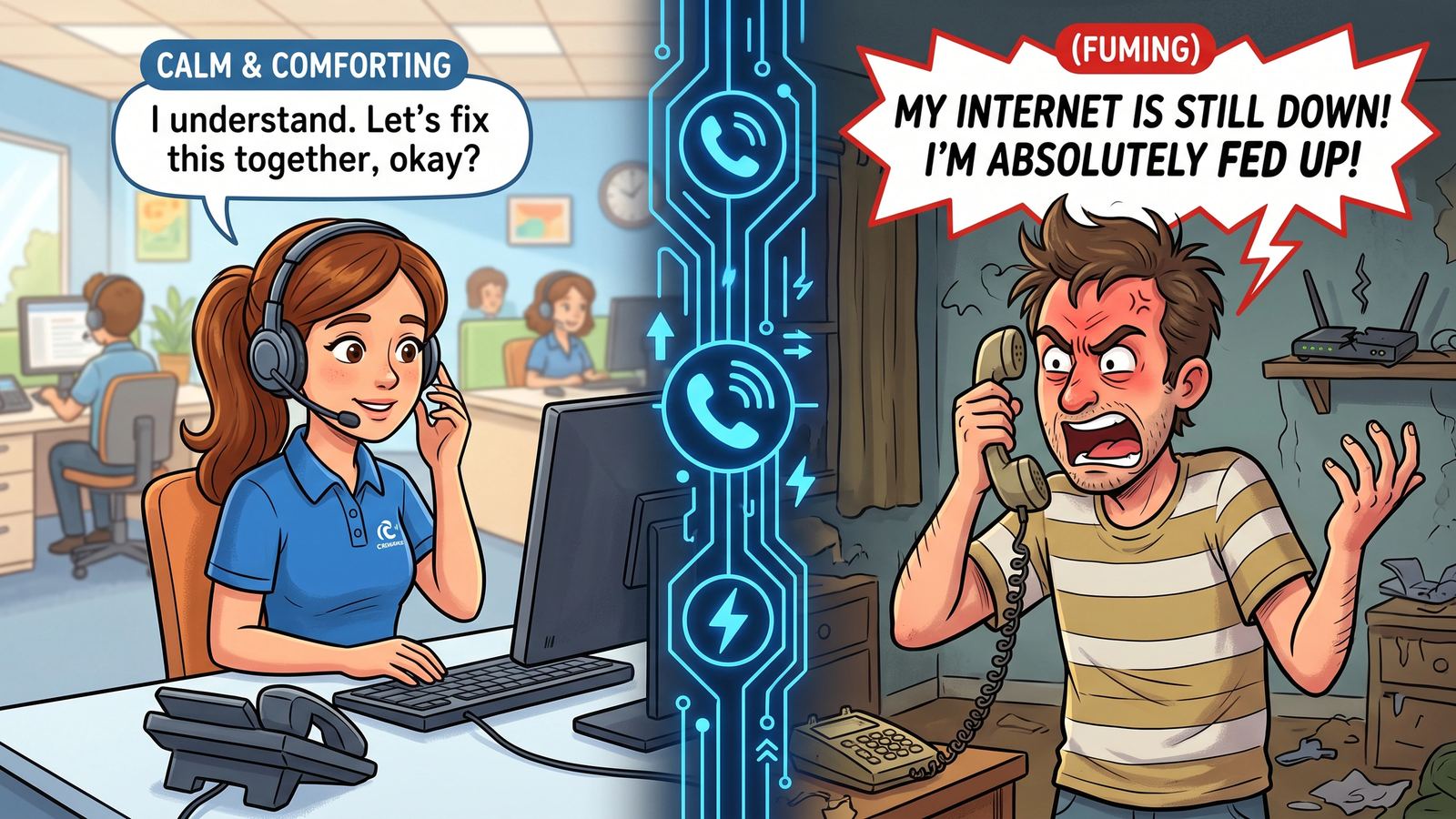
Explain to the interviewer that you let customers talk and, more importantly, you listen. Don’t interrupt to correct a detail, and don’t get defensive. When they pause, reflect it. “So the refund was supposed to arrive Friday, it’s now Tuesday, and no one called you back. Yeah, that would get me pretty upset as well.”
If the company hires you, they will expect you to use the techniques you told the interviewer. So you must adopt them as part of your job, not just have something good to say in an interview. They’ll see right through that.
If something goes wrong, take ownership, even if you didn’t cause it. Ownership doesn’t mean blame. It means, “I’m staying with this until we have an answer.” Then give a specific timeline. Not “soon.” Something like, “I’ll check the refund now, and I’ll tell you what I find before we hang up, even if it’s still processing.”
Practice out loud, even if it feels silly. Have a friend read you an angry complaint. Your job isn’t to solve it in five seconds. Stay calm, ask one clarifying question, and summarize what they said without arguing.
Turn what you’ve already done into proof
“I have no experience” is usually shorthand for “I’ve never had this exact job title.”
Did you work at a fast food restaurant? That’s customer service. If you interacted with customers in any manner, that’s customer service. So is tutoring, babysitting, volunteering, or helping family with appointments and paperwork. You’ve handled a long line, a wrong order, a tired or embarrassed customer. You’ve sorted out problems for real people, just in a different setting.

The trick is to stop listing traits and start telling short, specific stories.
Don’t just write “excellent communication skills.” Almost everyone writes that, and it tells a hiring manager nothing. Write the moment instead, in three or four sentences: describe the situation, show how you took action, and explain the result.
“At a busy cafe, a regular’s order was made wrong twice during lunch. I apologized, remade it myself instead of handing it off, and gave her a clear wait time so she didn’t have to keep checking. She came back the next week and asked for me by name.”
Prepare two stories before you apply anywhere. One about an upset person. One about a mistake you caught or fixed. Then be honest about the gaps: “I haven’t worked in a call center, but I’ve handled complaints face to face, I’m comfortable learning new systems, and I stay calm when someone is upset.” Many remote roles include paid training for exactly that reason. They expect to teach you their tools. They can’t easily teach patience.
Practice the parts they actually test
Remote hiring often includes more than an interview. Expect a typing check, a listening exercise, or a scenario test where you pick the best response to a difficult customer.

Type accurately first, fast second. A fast reply full of errors slows everyone down. Practice ten minutes a day, and get used to typing notes while you listen. In a real shift, that split attention matters more than raw speed.
Listen for the question behind the question. A caller who says “I’ve called three times” isn’t just giving history. They’re telling you they don’t trust the process anymore. Your answer has to address that trust, not just the technical issue.
Practice moving between notes, a customer record, and a help article while talking out loud. Awkward in practice beats frozen on a real call.
For scenario questions, choose the calmest, most specific answer. Not the cleverest. Not the one that proves the customer wrong. The one that validates, clarifies, and moves toward a resolution. If it sounds like something you’d want to hear when you’re frustrated, it’s probably right.
Make remote work believable
Working from home sounds easy until you’re on hour six, alone, headset on, with no one to ask a quick question. Hiring managers want evidence you can manage on your own.
Choose a tranquil corner and a setup that won’t drop mid-call.
Test your internet before you apply. The role in the video above requires at least 15 Mbps download and 3 Mbps upload; you can check this at speedtest.net. Download is what comes into your computer. Upload is what goes out, including your voice. If you’re close to the minimum, a wired connection usually beats Wi-Fi, and it’s worth knowing your backup plan.
If you can, get a headset with a real microphone. A laptop mic picks up every dog, dishwasher, and passing car. Do a test call with a friend and ask, honestly, how you sound.
Think about schedule, too. Many support teams run seven days a week, including holidays, with shifts that change after a few months. If nights or weekends are genuinely impossible, that’s useful to know before you apply. If you can be flexible, say so clearly. Vague availability helps no one.
And protect yourself from scams. Remote job seekers get targeted constantly. A real employer pays you for training. A real employer doesn’t ask you to pay for equipment, software, a background check, or a starter kit. If an “interview” happens only over text chat and rushes you to deposit a check or buy something, walk away.
A simple seven-day plan
You don’t need a month of preparation. You need a focused week.
Day one: write two short stories based on past work or volunteering.
Day two: record yourself answering one angry-customer scenario and listen back.
Day three: rewrite your resume so every skill has an example.
Day four: practice typing notes while listening to a podcast.
Day five: test your internet, headset, and quiet space.
Day six: apply to a small number of roles you’ve actually read.
Day seven: rest, then follow up tactfully.
Small, steady practice beats a frantic weekend of applications every time.
Chatbots now handle the easy stuff, so the calls that reach a human are messier and more emotional. That’s your opening, not a disadvantage. You don’t have to know every system on day one. Listen first, stay with the problem, and leave the person feeling a little less stuck than when they called.
The video above walks through one concrete example: an inbound customer service role with no cold calling, paid training, and a high school diploma or GED plus zero to three years in a customer-facing role. ZipRecruiter estimates it at $17.50 to $23.50 per hour, so check the listing for current details. Use it as a test case, then apply the tips above to make your next application sound like you at your steadiest, on your best day.
Link from the video: https://getpaidbootcamp.com/healthcare-admin-customer-service